
Frequently Asked Questions
There are many factors involved in when or if you need a DOT number but generally, anyone operating in commerce and crossing state lines with a vehicle or combination of vehicles with a greater than 10,000 pounds GVWR or GCWR must have a DOT number.
There are other details we need to give you an accurate answer for your situation. Please call the FMCSA office at 605-224-8202 or the SDHP Motor Carrier Services at 605-224-SEMI(7364) for a more complete and accurate answer.
Yes. South Dakota does not have weekend or holiday restrictions. Depending on the size of the load and your route, you may be limited to daylight hours. Oversize movements are generally restricted to daytime movement only unless you are less than 10 feet wide and will only travel on the interstate. Please check the details of your permit, or give us a call at 605-773-SEMI(7364) to check on any limitations you need to plan for.
Yes! We can provide information in several areas. We’d be happy to speak at your company safety meeting about hours of service, what to expect during an inspection, safe driving habits, drug and alcohol awareness, or just about any subject dealing with the motor carrier industry.
If you need assistance with weighing your truck to find your max legal weight, we can help with that too. Please give us a call to arrange for us to come to you. Contact us at 605-224-SEMI (7364) and we can schedule a day that works for you.
No, a tarp is not required, however the vehicle must be constructed or loaded as to prevent the load from dropping, leaking or sifting or otherwise escaping. You don’t have to tarp it, but nothing can fall off.
The full statute can be found at SDCL 32-15-18
We often get complaints when a driver gets a windshield chip from leaking gravel, rocks, or other objects. A trooper is unable to write a ticket for this unless the trooper witnesses something falling off the load. If this happens to you, if you have enough details such as license plate numbers of the vehicle, time, location, and other details, the county State’s Attorney may be able to assist you. Often the vehicle’s company is able to assist as well so you can try to contact them.
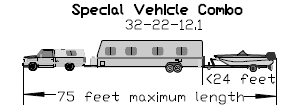
Probably. You can use a pickup to pull a bumper hitch or 5th wheel camper, with a boat behind the camper. The total combination from front bumper to the rear of the boat, including the motor, cannot exceed 75 feet, and the rear trailer including the load, cannot exceed 24 feet. There are some other hitch and weight provisions, so please see the full statute link below. Please be aware that different states have different laws on this type of combination. Some allow different lengths, some may not allow it at all. Please check with individual states before making your trip.
The full text of the law can be found at SDCL 32-22-12.1
All vehicles, or combination of vehicles whose gross weight exceeds 10,000 pounds must stop at the ports of entries or temporary truck checks. Rental trucks e.g. U-Haul or Ryder trucks, must stop. There are two exceptions, recreational vehicles and motor coach passenger buses are not required to stop.
The full state law is SDCL 32-33-17